
Introduction
If you’ve typed “Page Size Checker Spellmistake” into Google and landed here, you’re probably not alone. Search engines see this exact phrase pop up more often than you’d think, usually from people trying to find a tool that checks the size of a webpage, an image, or a document, but who accidentally added an extra word or misspelled something along the way. It happens to the best of us — autocorrect, muscle memory, or just a quick typo while multitasking.
In this article, we’ll unpack what people actually mean when they search for a Page Size Checker Spellmistake, why these odd search phrases show up so frequently, and how you can find the exact tool you need without wading through irrelevant results. We’ll also look at how page size checking tools work, why they matter for SEO and web performance, and what to watch out for when choosing one.
What Does “Page Size Checker Spellmistake” Actually Mean?
Let’s clear the air first. There isn’t a specific, widely recognized software product called “Page Size Checker Spellmistake.” Instead, this phrase is almost always the result of a typing error or a misremembered tool name. Someone searching for a page size checker — a utility that measures how large a webpage or file is in kilobytes or megabytes — may have accidentally typed “spellmistake” instead of something else, or added it while trying to search for spelling-check tools separately.
This kind of search term blending is incredibly common on the web. People often combine two ideas in one search bar, especially on mobile devices where typing is less precise. So when someone searches Page Size Checker Spellmistake, they’re usually looking for one (or both) of these things:
- A tool to check the size of a webpage, image, or document
- A tool to check spelling errors on that same page
Understanding this distinction is the first step toward finding what you actually need.
Why Do People Search With Typos Like This?
Typos in search queries aren’t a sign of carelessness — they’re a natural part of how humans interact with search engines. Our brains often think faster than our fingers type, especially when we’re trying to remember a tool name we saw once in a blog post or forum thread.
Here are a few common reasons search phrases like Page Size Checker Spellmistake show up:
- Autocorrect interference — Mobile keyboards sometimes “correct” a word into something unintended.
- Merged search intent — The user wants two different things (page size and spelling checks) and types both into one query.
- Memory recall issues — They remember using a tool once but can’t recall its exact name.
- Voice search errors — Speech-to-text tools sometimes mishear technical terms and produce odd combinations.
Search engines are actually quite good at recognizing these patterns now, which is part of why you’re seeing helpful results even for a phrase like this one.
What Is a Page Size Checker, Really?
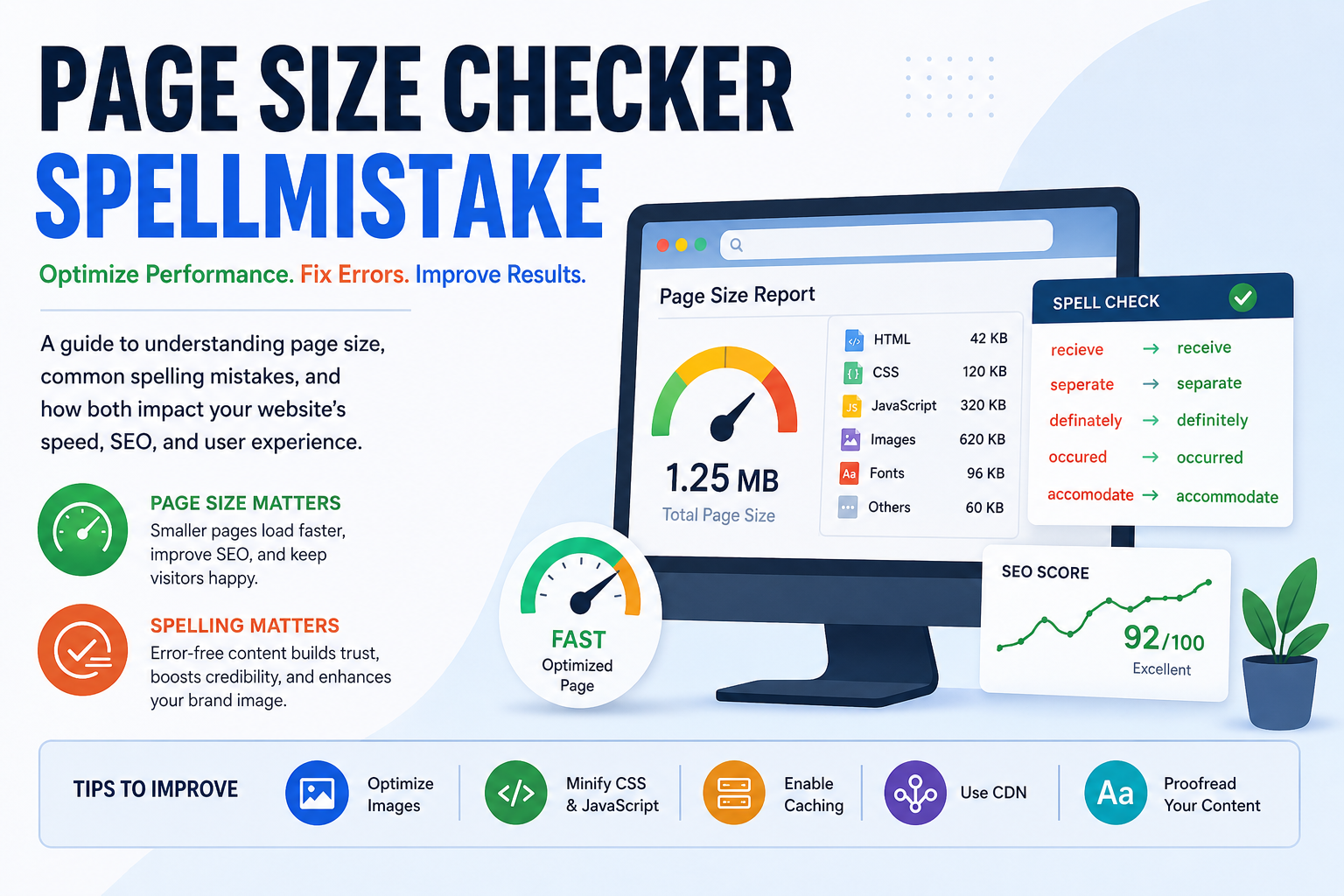
Now let’s get into the practical part. A page size checker is a tool — usually free and browser-based — that tells you how large a webpage is in terms of total file size. This includes everything that loads when a visitor opens your page:
- HTML code
- CSS stylesheets
- JavaScript files
- Images and media
- Fonts and other embedded assets
The output is typically measured in kilobytes (KB) or megabytes (MB), giving you a clear picture of how “heavy” your page is. This matters more than most people realize.
Why Page Size Matters for Your Website
A bloated page doesn’t just look bad on paper — it actively hurts your website’s performance. Here’s why page size is worth paying attention to:
- Slower load times for visitors, especially on mobile networks
- Higher bounce rates, since users abandon slow-loading pages quickly
- Lower search rankings, as page speed is a confirmed Google ranking factor
- Increased hosting and bandwidth costs for larger sites
Even a difference of a few hundred kilobytes can noticeably affect how fast your page loads, particularly for users on slower connections or older devices.
How a Page Size Checker Tool Works
Most page size checker tools function in a similar way, even if the interface looks different from one tool to the next. Here’s the general process:
- You enter a URL into the tool.
- The tool fetches the page just like a browser would.
- It calculates the total size of all resources loaded (HTML, CSS, JS, images, etc.).
- It displays a breakdown, often showing which elements are taking up the most space.
Some more advanced tools go a step further, offering suggestions for compression, image optimization, or code minification. This is genuinely useful if you’re trying to improve site speed without hiring a developer.
Page Size Checker Spellmistake vs. Spell Checker Tools
It’s worth separating these two categories clearly, since the confusion behind the phrase Page Size Checker Spellmistake often comes from mixing them up.
Page size checkers focus purely on file size and load performance. They don’t look at grammar, spelling, or content quality at all.
Spell checkers, on the other hand, scan your written content for spelling and grammar mistakes. Tools like Grammarly, Hemingway Editor, or even built-in browser spell-check features fall into this category.
If your original intent was to check both — how fast your page loads and whether your content is free of spelling errors — you’ll actually need two separate tools, since no single mainstream tool combines both functions under one roof. That’s likely part of why searches like Page Size Checker Spellmistake happen: people are looking for a two-in-one solution that doesn’t quite exist yet in a well-known form.
How to Choose the Right Page Size Checker Tool
With so many free tools available, picking the right one can feel overwhelming. Here’s what to look for based on real-world use:
Accuracy and Detail
A good tool should break down page size by resource type — showing you exactly how much space images, scripts, and stylesheets are taking up. This detail helps you prioritize what to fix first.
Speed Insights Included
Many modern tools bundle page size data with load time metrics, giving you a fuller picture of performance rather than just a single number.
Mobile vs. Desktop Comparison
Since mobile and desktop versions of a page can load different assets, the best tools let you check both separately.
No Sign-Up Required
For quick checks, a browser-based tool that doesn’t require account creation saves time and hassle.
Actionable Recommendations
Some tools simply report numbers, while better ones suggest fixes — like compressing a specific image or deferring a script — which makes the results far more useful.
Common Mistakes People Make When Checking Page Size
Even with the right tool in hand, people often misinterpret the results. Avoid these common pitfalls:
- Ignoring mobile results — A page might be fast on desktop but sluggish on mobile due to different asset loading.
- Focusing only on total size — Sometimes one massive image is the real culprit, not the overall page weight.
- Not rechecking after changes — Optimizations should always be verified with a follow-up scan.
- Confusing page size with page speed score — These are related but not identical metrics; a small page can still load slowly due to server response time.
Practical Steps to Reduce Page Size
If your page size checker results come back higher than expected, here are proven steps to bring that number down:
- Compress images using formats like WebP instead of large PNGs or JPEGs.
- Minify CSS and JavaScript to remove unnecessary characters and whitespace.
- Enable lazy loading so images only load as users scroll to them.
- Remove unused plugins or scripts that add weight without adding value.
- Use a content delivery network (CDN) to serve assets more efficiently.
These changes, even done gradually, can shave significant load time off your page — often improving both user experience and search rankings.
Final Thoughts on Page Size Checker Spellmistake
At the end of the day, a search like Page Size Checker Spellmistake usually reflects a simple, understandable mix-up rather than a mysterious tool nobody can find. Whether you meant to search for a page size analyzer, a spelling checker, or both, the good news is that reliable, free tools exist for each purpose.
The key takeaway is this: page size and spelling accuracy both matter for a website’s success, but they’re solved by different tools entirely. Once you know which one you actually need, finding it becomes a lot easier — no more guessing at odd search phrases required.
5. FAQ Section
Q1: What does “Page Size Checker Spellmistake” mean exactly?
It’s typically a misspelled or merged search query from someone looking for a tool to check webpage file size, sometimes combined with an intent to also check spelling on their site content.
Q2: Is there an actual tool called “Page Size Checker Spellmistake”?
No, there’s no widely known tool with that exact name. It’s almost always a typo or a blended search phrase rather than a specific product.
Q3: How do I check my webpage’s file size?
You can use free online page size checker tools that let you enter your URL and instantly see a size breakdown by resource type, including images, scripts, and stylesheets.
Q4: Does page size actually affect SEO rankings?
Yes, page size directly impacts load speed, which is a confirmed ranking factor. Smaller, well-optimized pages generally load faster and perform better in search results.
Q5: What’s the difference between a page size checker and a spell checker?
A page size checker measures the total file weight of a webpage for performance purposes, while a spell checker scans written text for grammar and spelling errors. They serve completely different functions.
